Introduction
Imagine this.
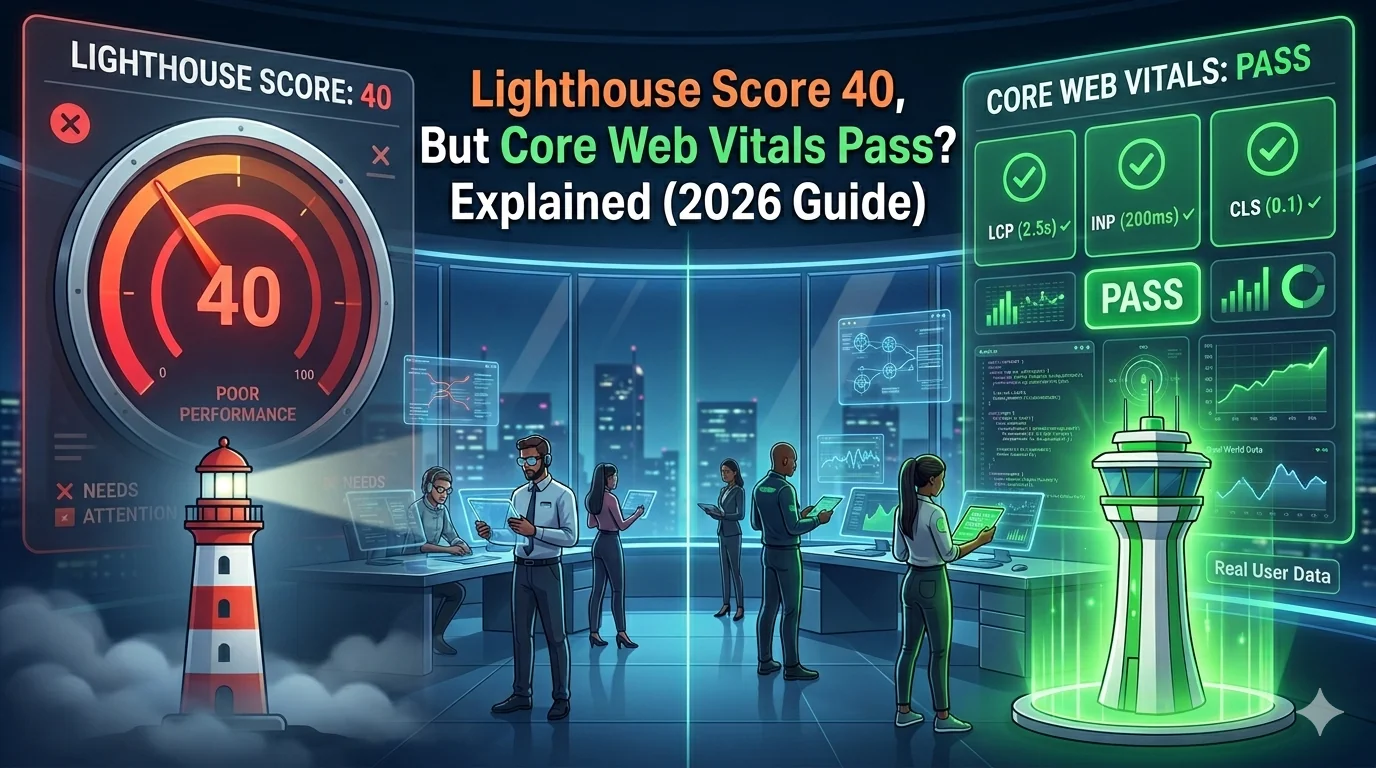
You’ve just launched your website. You open Chrome DevTools, run a Lighthouse audit… and boom.
Performance: 40.
Your heart sinks.
You start thinking:
- “Google will destroy my rankings.”
- “Users will leave instantly.”
- “Something is seriously broken.”
Then you open Google Search Console and check the Core Web Vitals report.
Status: PASS.
Wait… what?
How can your site be failing in one place and passing in another?
Welcome to one of the most misunderstood concepts in modern web performance.
Related guides: Debugging hidden LCP issues when PageSpeed Insights passes, viewport width, resolution, and why 412px matters in Lighthouse, the 28-day CrUX rolling window behind Core Web Vitals reports, and how CrUX collects real user performance data end-to-end.
🧠 Two Worlds: Lab vs Real Life
To understand this paradox, you need to know that performance is measured in two completely different ways.
🧪 Lab Data (Your Lighthouse Score)
Tools like Lighthouse simulate performance in a controlled environment:
- Slow 4G network
- Mid-tier mobile device
- Cold cache (first-time visit)
It’s intentionally harsh.
Think of it as a stress test.
🌍 Field Data (Core Web Vitals)
Core Web Vitals, powered by real-user data from Chrome User Experience Report, measure how actual users experience your site:
- Different devices (some fast, some slow)
- Real networks (often faster than simulated 4G)
- Cached visits
This is real life.
⚖️ Why You Can “Fail” and Still “Pass”
Let’s break it down.
Your Lighthouse score might be low because:
- JavaScript is heavy
- Some resources block rendering
- The page isn’t optimized for worst-case conditions
But Core Web Vitals only care about three specific things:
- LCP (Largest Contentful Paint) -> How fast main content loads
- INP (Interaction to Next Paint) -> How responsive interactions feel
- CLS (Cumulative Layout Shift) -> How stable the layout is
👉 If these three are good for most real users, you pass.
Even if everything else is messy.
🎯 A Real-World Analogy
Think of Lighthouse like a doctor stress test.
It pushes your body to the limit and says:
“Under extreme load, you’re not doing great.”
Core Web Vitals is more like:
“In normal life, you’re functioning fine.”
Both can be true. And both are useful - if you interpret them correctly.
⚠️ The Hidden Risk Most Developers Ignore
Here’s where things get dangerous.
A Lighthouse score of 40 with passing Core Web Vitals means:
👉 You’re getting away with it… for now.
Why?
Because:
- Users on slower devices may already struggle
- Future updates (like heavier features) can break CWV
- New users (no cache) will experience the worst version of your site
In short:
You’re standing on thin ice - it just hasn’t cracked yet.
📊 What Google Actually Says
According to Google:
- Core Web Vitals are part of page experience signals
- They are based on real-user data (field data)
- Lab tools like Lighthouse are for debugging and improvement
👉 Source:
- Chrome UX Report methodology
- Core Web Vitals thresholds
- Search Console Core Web Vitals report
- PageSpeed Insights
For deeper context on field data timing, see:
🧭 So What Should You Trust?
The answer is: both - but for different reasons.
| Tool | Purpose |
|---|---|
| Lighthouse | Find problems (diagnostics) |
| Core Web Vitals | Measure real user impact |
Ignoring either one is a mistake.
🚀 A Smarter Way to Measure Performance
Instead of chasing a perfect Lighthouse score, do this:
✅ Step 1: Check real-world performance
- Use Google Search Console
- Look at Core Web Vitals status
✅ Step 2: Diagnose issues
- Use Lighthouse
- Fix high-impact problems
✅ Step 3: Validate improvements
- Recheck in PageSpeed Insights
- Monitor field data over time
🧩 The Final Takeaway
Yes - your site can score 40 in Lighthouse and still pass Core Web Vitals.
But that’s not a success story.
It’s a warning sign disguised as a green checkmark.
Conclusion
💬 Closing Thought
Performance isn’t about chasing scores.
It’s about delivering a fast, stable, and responsive experience - for real people, not just simulated tests.
So next time you see that low Lighthouse score, don’t panic…
But don’t ignore it either.
Key Takeaways
- Lab and field data are different: Lighthouse is a controlled stress test; Core Web Vitals reflect real user experience.
- Passing Core Web Vitals is about LCP, INP, and CLS: if those are good for most real users, you can pass even with a low Lighthouse score.
- A low Lighthouse score is still a signal: it often points to worst-case and first-visit pain that can break CWV later.
- Use both tools: field data to measure impact, lab data to find and fix the causes.