Introduction
After years of working across engineering teams, one pattern becomes clear: the engineers who struggle most in compensation conversations aren’t the ones who’ve contributed the least. They’re the ones who haven’t learned to articulate their contribution effectively.
Listing projects, quoting years of experience, or simply stating “I deserve more” rarely moves the needle in an appraisal. What does work is a structured, evidence-based case that speaks the language of business value - logical, composed, and hard to dismiss.
The ISOM Framework - Impact, Scale, Ownership, Market Alignment - is built precisely for this.
The Core Framework
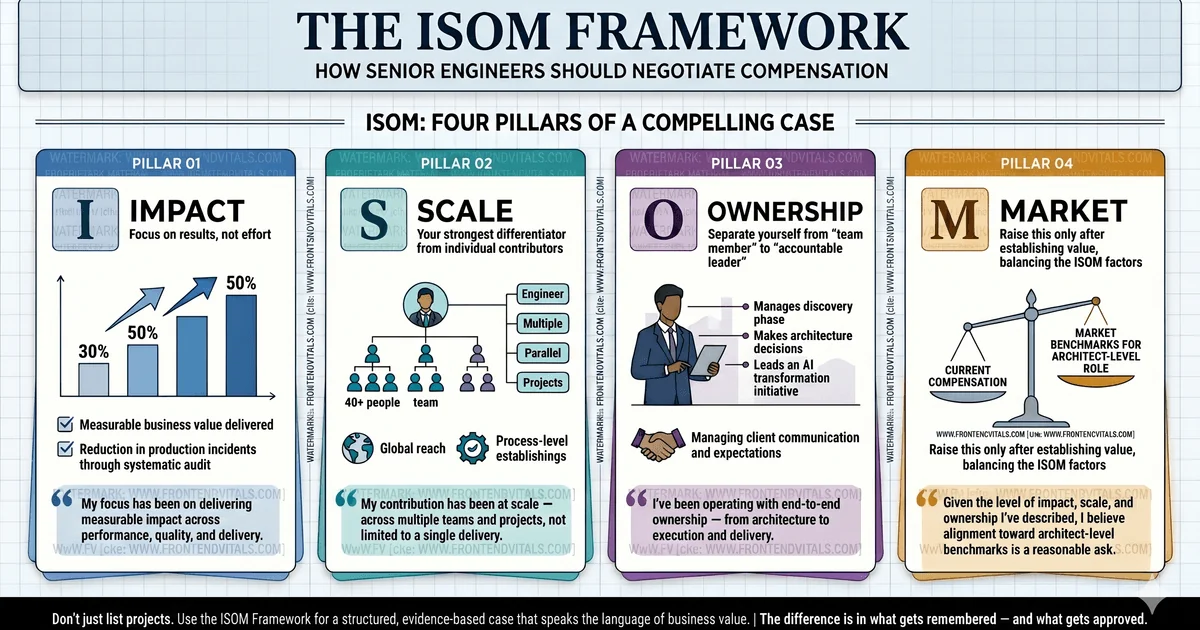
ISOM: Four Pillars Of A Compelling Case
Each element builds on the last - from demonstrating value, to proving scope, to justifying reward.
| Pillar | What It Means |
|---|---|
| Impact | Measurable business value delivered |
| Scale | Breadth and reach of your influence |
| Ownership | End-to-end accountability you held |
| Market | Benchmarks that justify compensation change |
Pillar 01: Impact - What Value Did You Create?
The most common mistake engineers make is describing what they did rather than what it achieved. Appraisals are business conversations. Frame your contributions in terms of outcomes.
Examples:
- Performance improvements of 30–50% through targeted optimisation
- Reduction in production incidents through systematic audit and validation
- On-time, high-quality delivery of key client projects
“My focus has been on delivering measurable impact across performance, quality, and delivery.”
Pillar 02: Scale - How Far Did Your Influence Reach?
Scale is what separates a senior engineer from an architect or principal. If your work touched multiple teams, projects, or organisational processes, that must be made explicit - it rarely speaks for itself.
Examples:
- Leading and influencing a team of 40+ engineers
- Contribution spanning multiple parallel projects
- Establishing organisation-level engineering processes
“My contribution has been at scale - across multiple teams and projects, not limited to a single delivery.”
Pillar 03: Ownership - What Did You Personally Drive?
Ownership is the bridge between doing and leading. If you were the person who made decisions, absorbed risk, and drove direction - say so directly. Don’t let this get lost in collective language.
Examples:
- Architecture decisions and technical direction
- Leading discovery phases and scoping work
- Managing client communication and expectations
- Driving AI transformation initiatives within the engineering org
“I’ve been operating with end-to-end ownership - from architecture to execution and delivery.”
Pillar 04: Market Alignment - Why Should Compensation Change?
Market benchmarking is your closing argument - not your opening one. After establishing the scope and weight of your contributions, compensation alignment becomes a natural, logical conclusion rather than a demand.
Examples:
- Responsibilities are consistent with architect-level scope
- Current compensation is below market benchmarks for the role
“Given the level of impact, scale, and ownership I’ve described, I believe alignment toward architect-level benchmarks is a reasonable ask.”
Putting It Together: The One-Minute Appraisal Statement
Here’s how ISOM sounds in a real conversation - structured, composed, and specific.
“Over the past cycle, my contribution has been focused on delivering measurable impact - through performance improvements, successful project deliveries, and improving engineering quality through audits and validation processes.
At the same time, my role has expanded significantly in scope, with contribution across multiple projects and active leadership of a team of 40+ engineers.
Beyond execution, I’ve taken ownership of architecture decisions, participated in discovery phases, led client discussions, and driven AI transformation initiatives within the team.
Considering this level of impact, scale, and ownership, I believe my current compensation is not fully aligned with market benchmarks for this level of responsibility - and I was expecting a stronger alignment this cycle.”
Why It Works: The Structure HR Cannot Easily Dismiss
The framework is effective because it is logical, structured, and non-emotional. It makes the case before asking for anything - which is the order that actually works.
| Element | What It Signals |
|---|---|
| Impact | Business value delivered - connects your work to organisational outcomes |
| Scale | Seniority - demonstrates you’re operating above individual contributor level |
| Ownership | Leadership - shows accountability and decision-making authority |
| Market | Justification - grounds the ask in data, not emotion |
What Not To Say: Common Statements That Don’t Justify Compensation
- “I worked on many projects this year” - describes volume, not value
- “I have 12 years of experience” - tenure is not a business case
- “I deserve more” - feelings don’t anchor salary decisions
None of these statements connect your work to outcomes the organisation cares about. Replace them with the ISOM structure.
Advanced Technique: Anchor A Range Without Diminishing Your Ask
If you want to signal reasonableness without diminishing your ask, close with a positioning statement that anchors the conversation in a fair range rather than a specific number:
“I’m not looking for the top of market - I’m looking for alignment closer to the mid-to-upper band for this level of responsibility.”
This framing makes you appear strategic and collaborative rather than adversarial - and it’s considerably harder for HR to push back on.
Summary: The ISOM Framework At A Glance
- Impact: What measurable outcomes did you deliver?
- Scale: How broadly did your influence extend?
- Ownership: What did you personally drive and decide?
- Market: Why should your compensation move now?
The next time an appraisal conversation comes around, don’t walk in with a list of projects. Walk in with a structured argument. The difference is in what gets remembered - and what gets approved.
Conclusion
Key Takeaways
- Lead with outcomes: frame your work as measurable Impact, not effort.
- Make Scale explicit: highlight cross-team reach, process changes, and organisational leverage.
- Claim Ownership clearly: distinguish accountability, decision-making, and direction-setting.
- Use Market last: once the case is built, benchmarks make the ask logical instead of emotional.